LOUD ONE: a 24-second 3D product film in code
Higgsfield made a 24-second 3D product film called LOUD ONE by applying Higgsfield Katana to Claude Motion. They say it used no Blender, Cinema 4D or After Effects, and that they gave it 3 hours.
Prompt
Quoted verbatimNeeds inputs or extra tools
<inputs>

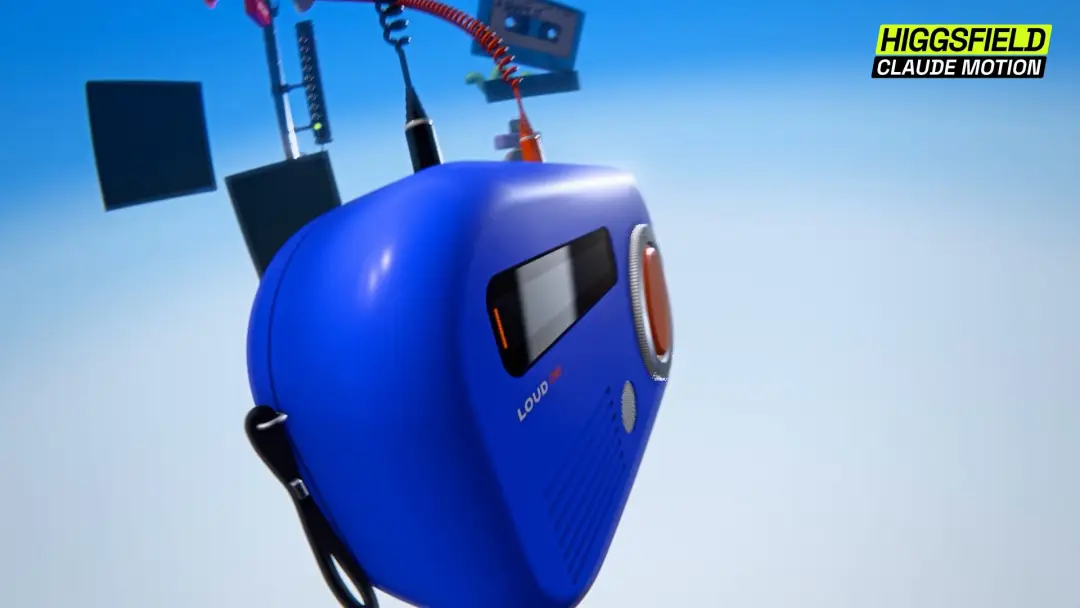
Defaults: product name LOUD ONE; 1920 × 1080; 30 fps; exactly 24 seconds and 720 frames; a cobalt-blue handheld music device with a large orange control, black LED display, speaker grille, silver hardware, and connected red and black cables.

Keep the reference's on-device copy unless replacement copy is supplied. Treat the preorder message as artwork for this recreation; do not invent a working purchase link.
</inputs>

<direction>
Create an energetic, glossy 3D product film with Higgsfield Katana and Claude Motion. The central idea is that a hummed idea travels through a playful world of musical hardware and becomes something ready to share.

The journey is HUM → SHAPE → DROP, ending with LOUD ONE.

Build a coherent floating installation in an open blue environment. The camera travels between physical objects suspended around a tall chrome mast: the hero device, speech-bubble display, horns, a recording light, meter, cassette, speaker stack, and LED letter panels.

The background is a saturated sky-blue to pale blue-gray gradient. Keep it spacious and luminous. There is no room, floor, horizon line, editor panel, or storyboard strip.

Use rounded industrial design, polished colored plastic, brushed and polished metal, dark rubber, and black perforated display surfaces. Objects should feel fabricated and dimensional even when their arrangement is playful.

Approximate palette: cobalt #173BD5, sky blue #158CEC, pale blue-gray #DCEAF1, orange #F34A13, cream #E8E5DE, violet #7137C4, lime #A9D53C, amber #E5AD35, and near-black #10151C. Refine against the reference.

Light the scene with large soft sources and sharp enough reflections to reveal the materials. Keep contact shadows between assembled parts. Preserve bright chrome highlights without losing detail in the white housing.

Use wide-angle product cinematography: close passes, changing perspective, orbiting, foreground occlusion, tilts, and fast travel between stations. Slow down when a message needs to be read.

Most typography belongs on physical objects. LED lettering should be made from a consistent dot grid. The main device types in white with an orange cursor; speech-bubble screens use warm-white dots, with orange emphasis; directional signs use amber.

Maintain the small HIGGSFIELD / CLAUDE MOTION badge at the upper-right as a separate overlay. Keep it fixed while the camera moves.

Avoid flat screenshots pretending to be 3D, unrelated montage inserts, excessive lens distortion, random glitch effects, or floating text detached from the objects.
</direction>

<structure>
Use these approximate reconstruction beats. Refine transitions against the reference while preserving the full 24-second runtime.

0:00–0:02.6 / HUM INTO THE DEVICE
Open close to the cobalt-blue hero device at an angle. Its rounded rectangular housing fills much of the image.

Show the recessed black LED display, speaker slots, small circular metal grille, top cable connections, LOUD ONE label, and large orange circular control surrounded by a ridged silver ring.

Type “hum me something...” across the display with an orange insertion cursor. Reveal the lettering as discrete LED states. As the camera approaches, change the screen to a recording treatment with a red REC indicator and an orange waveform.

Move across the front toward the orange control. Let changing reflections reveal the blue casing and machined ring. Keep the device stable as a rigid object.

0:02.6–0:05.6 / EVERY HIT STARTS AS A HUM
Pull away and travel toward a cream speech-bubble-shaped display mounted high on the chrome mast.

The housing has a soft rectangular screen and a pointed lower-left tail. A thin antenna extends upward; a black cable and red coiled cable connect below.

Begin with an empty black display, then reveal:
“EVERY HIT
STARTS AS A HUM.”

Use warm-white pixel lettering, centered inside the physical screen. Arrive at a readable angle and hold the finished sentence briefly.

Below the display, show a dark metal collar and several small colorful horn speakers. Keep the mechanical connections plausible.

0:05.6–0:08.2 / FOLLOW THE SOUND
Move down and around the mast. Pass the horn cluster, chrome brackets, exposed connectors, and coiled wires.

Reveal a glowing red “ON AIR” sign. Continue past a vertical meter containing circular lamps that rise through green, yellow, and red.

Use changes in distance and perspective to connect the objects. Let the hero device remain visible farther away on its cables.

Add a few suspended green and purple waveform-like squiggles, but keep them secondary. Use the mast, cables, and nearby objects to preserve spatial orientation through the fast camera travel.

0:08.2–0:10.6 / SHAPE IT
Travel toward a large floating cassette. Show it turning from an oblique view into a readable frontal presentation.

Build a dark blue-gray shell with a cream label, two visible reels, transparent windows, screws, seams, and an orange slider along the upper edge.

Main label:
“SHAPE IT.”

Small selectable style labels:
“LO-FI”
“HOUSE”
“FUNK”
“DISCO”

Move the orange control across the choices while the cassette shifts slightly in space. Give the reels subtle rotation. Preserve crisp readable text and realistic thickness at the casing edges.

Use a passing edge or fast turn to carry the camera into the next station.

0:10.6–0:13.5 / DROP IT
Find a narrow black LED sign above a floating audio stack.

Animate amber directional arrows into:
“DROP IT.”

Travel down the stack. Include a small black speaker, a purple rectangular unit, a yellow drum-like speaker body, a cream speaker with an orange cone, and a broad cobalt unit at the bottom.

Add a glossy red exclamation mark beneath the stack. Let the objects respond with controlled movement as the camera passes.

Keep speaker cones circular and their movement axial. Make this section feel like the energy of the musical idea has increased.

0:13.5–0:16.4 / SPELL OUT LOUD
Swing across a group of separate square black LED panels mounted along slender supports.

Reveal the letters L, O, U, D in amber dots. Individual panels rotate or pass through different orientations as the camera moves.

The letters should be legible at their key moments, with the full arrangement becoming understandable through the travel. Maintain the same world, lighting, and hardware language.

Use a fast but readable camera arc to return toward the speech-bubble display. Let a few rounded orange and purple shapes pass in the foreground.

0:16.4–0:20.4 / IDEAS, OUT LOUD
Return to the cream speech-bubble display.

Briefly show a small waveform, then reveal:
“IDEAS,
OUT LOUD.”

Keep IDEAS and OUT warm white. Make LOUD orange.

Hold a readable three-quarter view while the installation moves subtly. Keep the horn cluster, collar, hanging cables, green squiggle, and distant DROP IT sign visible as secondary details.

Near the end of this section, change the display to:
“LOUD
ONE”

Use a fast pullback to reconnect the display with the wider installation.

0:20.4–0:24 / PRODUCT HERO
Bring the cobalt device back into the foreground, suspended by its black and red cables.

Settle it left of center at a flattering three-quarter angle. The large orange control, chrome ring, speaker slots, and rounded casing must remain recognizable.

Place the four amber LED letter panels spelling LOUD to the right, arranged along their slender supports.

Change the device display from “LOUD ONE” to “PRE-ORDER NOW.”

End with a readable hero composition and subtle residual movement. Hold long enough to recognize the product and CTA. Do not force a loop or add an unrelated end card.
</structure>

<build>
1. Use an editable 3D scene and camera in the supported Katana/Claude Motion workflow. Three-dimensional objects must retain their shapes during camera travel. Use the available 3D renderer or supported scene pipeline rather than flattening the whole film into image cards.

2. Build a reusable asset library: hero device, orange dial, LED display surface, speech-bubble housing, mast, horns, ON AIR sign, meter, cassette and slider, speaker components, letter panels, cables, and decorative waveform shapes.

3. Keep geometry, materials, displayed text, lights, camera paths, animation, and branding individually editable. Centralize product name, messages, colors, and beat timings.

4. Place all stations in a shared scene. Plan the camera route before polishing detail. Use foreground objects and whip movements to bridge sections, keeping changes of direction physically understandable.

5. Use a master time function with 720 output frames at 30 fps. Seed randomness. Make each frame directly seekable and repeatable; avoid animation that depends on previous playback.

6. Construct cables with spline-based geometry. Keep endpoints attached to their ports. Give cable curves and suspended devices a small amount of secondary movement that settles after major camera or object actions.

7. Render LED text with proper display-space perspective and a stable dot grid. Use crisp message changes rather than morphing letters into unreadable intermediate glyphs.

8. Use motion blur for fast travel and passing objects, then restore clarity during text holds. Adjust focus for each subject rather than keeping the entire installation equally sharp.

9. Keep the top-right HIGGSFIELD / CLAUDE MOTION badge in screen space. It must not inherit scene blur, perspective, or exposure changes. Supply an unbranded export too if requested.

10. Inspect the supplied audio to place accents. If a new score is needed, propose a playful electronic groove that builds from a simple hummed motif into a fuller arrangement. This is a sound direction, not a claim about the source track.

11. Add focused sound details: a recording click, dial tick, relay or lamp activation, cassette movement, speaker pulse, and restrained pass-by sounds. Let the DROP IT moment receive a stronger musical accent. Keep the final product hold musically resolved.

12. Render a preview first. Check the whole camera route and every text hold before final-quality lighting and export.

Deliver KATANA_Pack_1_LOUD_ONE_1080p_30fps.mp4, the editable project or source, organized assets, and separate audio stems where available.
</build>

<gotchas>
The hero product is LOUD ONE. Do not substitute PHYLLA or the OBSCURA branding from other references.

Keep the large orange dial on the same side of the device throughout. Maintain cable ports, screen placement, grille layout, and physical scale.

LED text lives inside the screens and signs. It must not slide independently of their surfaces.

Do not detach cable ends during the camera moves. Avoid cable intersections with the hero device and screen housing.

The speech-bubble display needs readable front-facing moments. A beautiful extreme angle is not useful if the sentence cannot be read.

Fast camera movement should connect destinations. Avoid random spins with no clear arrival.

Keep the cassette and speaker stack distinct. Preserve the visible style-selection labels and the orange slider.

Chrome reflections must support form. Avoid blown-out rings and shimmering highlights.

The final product hold is part of the film. Do not spend all 24 seconds moving and leave the CTA for a single frame.

No code sidebar, external editor frame, botanical imagery, or extra promotional statistics belong in this reference.
</gotchas>

<start>
Inspect the reference and collect any missing original assets in one question.

Show the asset list, camera route, timing map, and six stills: opening device, speech-bubble message, mast/ON AIR detail, cassette, speaker stack, and final hero.

Build the editable blocking pass, review movement and readability, then finish materials, lighting, sound, and the final render.
</start>
Details
- Model
- Claude Motion
- Type
- Video
- Iterations
- Not stated
- Build time
- 180 min
- Posted
- Oct 9, 2026
Sources
- X@higgsfield_aihttps://x.com/higgsfield_ai/status/2108372803464692139Oct 9, 2026 · 268 likes